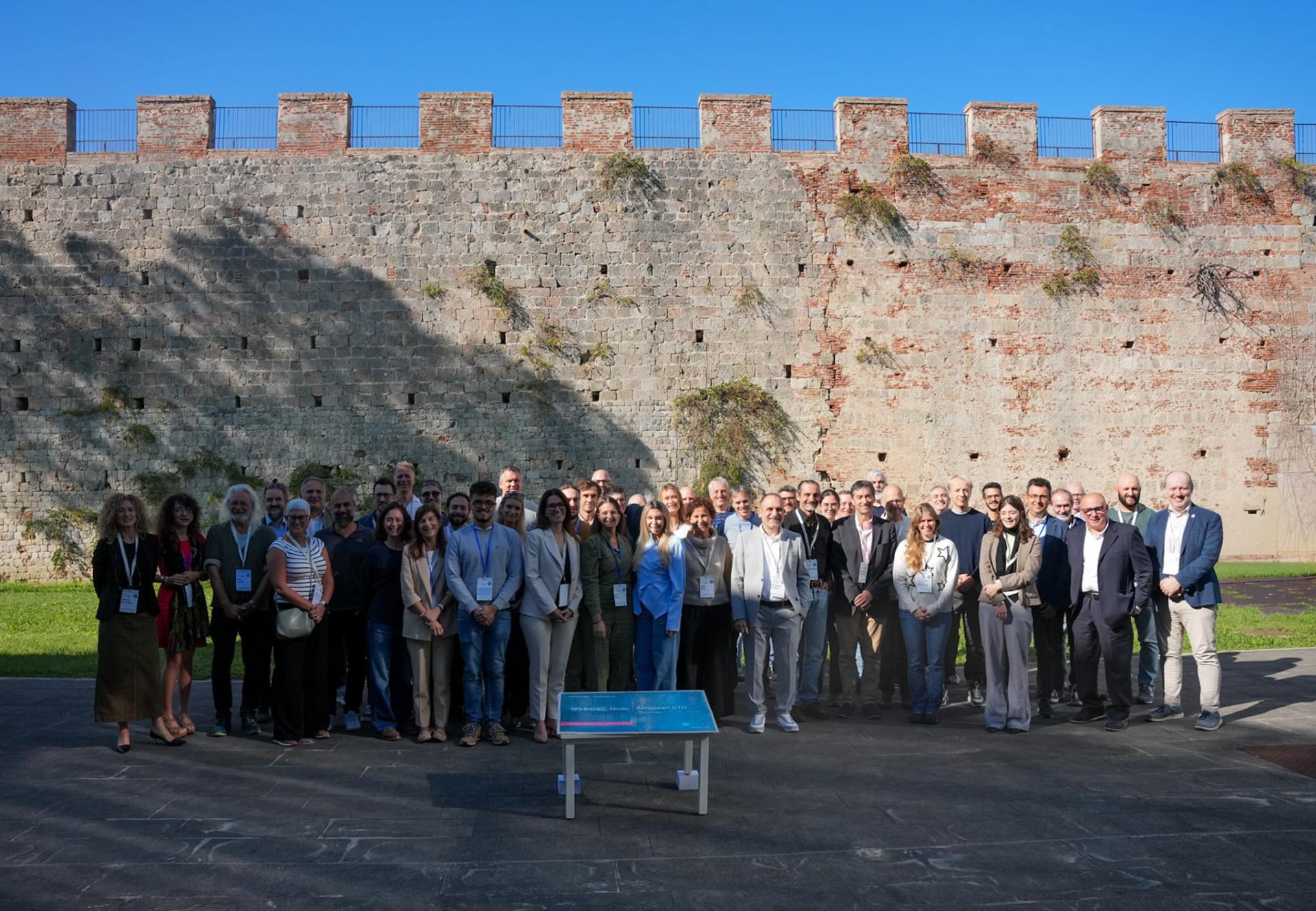
EOSC Marine kicks off in Pisa and sets the EOSC Node European Digital Twin Ocean in operation.
Europe's marine research community is used to working across borders, disciplines and infrastructures. With the EOSC Federation now in production, the next step is to make marine data, tools and computing resources work together within a single, trusted open science ecosystem. This is the mission of EOSC-Marine, the project supporting the operation and evolution of the EOSC Node European Digital Twin Ocean.
On 12 and 13 October 2026, partners and guests met at Officine Garibaldi in Pisa, Italy, for the EOSC-Marine face-to-face kick-off meeting. The first day was a closed consortium meeting and the second was a hybrid open event. The meeting came just days after the node was confirmed as one of the first 14 EOSC Nodes to enter production on 8 October.
Day 1: from node capabilities to a shared work plan
After a welcome from Pasquale Pagano (CNR-ISTI), coordinator of EOSC-Marine and of the EOSC Node European Digital Twin Ocean, and Sara Pittonet Gaiarin (Trust-IT), the project manager, the consortium went straight to one of the project's core challenges: interoperability between EOSC and EDITO, the European Digital Twin of the Ocean platform. Chaired by Massimiliano Assante (CNR), the session reviewed the Node's federated capabilities, which cover authentication and authorisation (AAI), the catalogue, generic services and the federated help desk. It ended with the first user requirements from the thematic services, starting with fisheries stock assessment.
In the afternoon, Pasquale Pagano presented the Memorandum of Understanding that EOSC-Marine will sign with the EOSC Association, EOSC4ALL, EOSC-CONNECT and EOSC Mesh. Cyrielle Delvenne (VLIZ) then led the Data Services session, where partners presented their plans for data lakes, semantic mappings, UDAL and OpenEO, STAC catalogues, Galaxy workflows and reusable service templates. The day closed with Sara Bozzi (Trust-IT) presenting the communication, dissemination and training plan, including the editorial calendar, a shared glossary and the two open calls, which will distribute €270,000 to six projects.
Day 2: the EOSC Federation goes into production
The open day began with Ana Maria Teresa Mota (European Commission, DG RTD), who set out the European Commission's view on open science policy and the governance of EOSC. Bob Jones and Mario Reale (EOSC Association) then described the federation's move into production: 14 nodes, including the EOSC EU Node, contributing 124 services, with open questions on distributed catalogues, monitoring, help desks and service management. 34 of these services come from the EOSC Node European DTO.
Speakers from Mercator Ocean International presented EDITO's architecture, from its data lake and ARCO formats to the STAC catalogue. Pasquale Pagano described the European Digital Twin Ocean Node, which now has 64 services registered in EOSC. In September, 1,329 users were moved from Blue-Cloud to the Node's new platform. A first demonstration of integration between EDITO and the node's platform is planned for June 2027.
The morning continued with presentations from the EOSC Life Science Connect Node and the JERICO consortium of coastal observatories, showing how the node can serve wider communities, including through cross-node use cases.
The thematic services take shape
The afternoon was dedicated to the scientific heart of the project. Chaired by Marine Vernet (Ifremer), the session set out the work plans for the node's four thematic services:
- Ocean physics: scaling the temperature and salinity pipeline from the Mediterranean to the global ocean, presented by Simona Simoncelli (INGV)
- Coastal eutrophication and ocean acidification: extending harmonised data products and indicators to acidification data, led by OGS and presented by Nydia Catalina Reyes Suarez
- Fisheries status, assessment and visualisation: connecting the Global Record of Stocks and Fisheries, gridded fisheries data and stock assessment workflows, presented by Julien Barde (IRD) and colleagues
- Ocean biological carbon sequestration: a cross-node use case with the EOSC Life Science Connect node, linking ocean microbiome data with global models, presented by Stéphane Pesant (EMBL-EBI)
What's next
The coming months will be about putting these plans into practice. The node will complete its remaining EOSC Federation capabilities by the end of 2026, the EDITO integration roadmap will move forward, and the first open call is being prepared. The thematic services will be tested with real users. The EOSC-Marine community leaves Pisa with a shared roadmap and a clear goal: making the European Digital Twin Ocean Node a reference Node for ocean science in the EOSC Federation.